- DLIM's Playbook
- Posts
- Internal Rotation Deficit and ACL Injury
Internal Rotation Deficit and ACL Injury
Written for PT students, early-career clinicians, and performance coaches pursuing football.

Devin Limerick
March 2nd, 2026
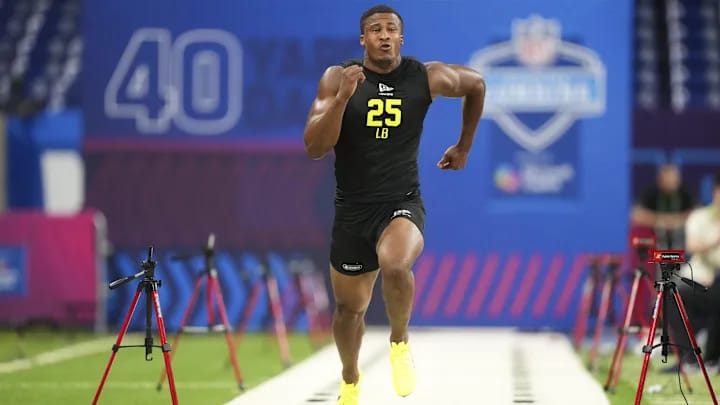
Good Morning! First Friday of the week. The combine wrapped up over the weekend and we saw some decent talent. Especially Sonny Styles with his insane metrics.
Speaking of the combine, the team’s sports medicine analysist is also looking at the players to see past injuries, any current underlying injuries, and potential for future injury. Which brings me us to the topic of todays newsletter about the correlation of a lack of internal rotation at the hip is associated with a higher risk of ACL injuries.

*The injuries discussed in this newsletter are for general educational purposes only. I am not affiliated with the athlete’s medical team, and the information shared does not reflect any insider or team medical details. Specifics about the injury are often unavailable, which can significantly influence the estimated timeline for return to play.
In football performance and clinical practice we invest heavily in strength, power, and reactive ability. But range of motion, especially in the transverse plane, can be overlooked.
A study published in Knee Surgery, Sports Traumatology, Arthroscopy examined elite football athletes attending the NFL Combine and found a clear association between restricted hip internal rotation and increased odds of ACL injury. The findings found that hip motion is a mechanical variable that matters in sports with a high demand for change of direction.
When the hip cannot internally rotate through functional ranges, athletes are more likely to expose the ACL to higher strain during dynamic maneuvers.
In the study, 324 football players at the 2012 NFL Combine had their hip internal rotation measured clinically. Across this cohort, 34 athletes (10.5%) had a documented history of ACL injuries requiring reconstruction. On average, hip IR in this population was near 21 degrees bilaterally, a number that becomes meaningful when correlated with injury patterns.
The statistical analysis showed that reduced hip internal rotation was associated with increased odds of both ipsilateral and contralateral ACL injury. For every 30-degree decrease in measured internal rotation on the left side, odds of an ACL tear increased approximately four-fold on the same side and more than five-fold on the opposite side.
This association is strong and clinically significant. A 20-degree versus a 40-degree IR is a mechanical difference with potential consequences when an athlete is cutting, pivoting, or decelerating at high speed.

The authors also used a model to simulate a pivot landing, a common mechanism in ACL injury. By reducing the available hip internal rotation in the model, they demonstrated that ACL strain increased as hip IR decreased. For each degree less of internal rotation, strain on the ACL increased. At 5 degrees of available hip IR, peak strain was significantly higher than at 10 degrees.
The restricted hip motion in this context is most often due to underlying hip morphology like cam deformities, femoral retroversion, or acetabular retroversion (femoroacetabular impingement, FAI). These structures limit internal rotation even before tissue stiffness or muscular guarding is considered.
It is about mechanically limited hip rotation due to bony anatomy that doesn’t allow the femoral head the clearance needed to internally rotate without impingement. When an athlete compensates around that limitation with pelvis or lumbar motion, the knee often gets a higher load of stress.

*Due to my professional association with the Atlanta Falcons during preseason and my current role with the Florida State Seminoles, I will not provide educational content or commentary on any injuries within these programs during or after the season.
ACL injury prevention interventions have traditionally focused on knee valgus, landing mechanics, and neuromuscular control. Those remain important. But a limitation at the hip can also be addressed.

Pre PT Grind is a holistic consulting platform designed specifically for the student who wants to become a physical therapist or a physical therapist assistant.
Pre PT Grind is dedicated to growing the physical therapy profession starting with YOU, the student.
YOU ARE THE FUTURE OF THE PHYSICAL THERAPY PROFESSION!